Translate

Showing posts with label Great Colinet Island. Show all posts

Wednesday, July 13, 2016

Great Colinet Island (2016) Part 3


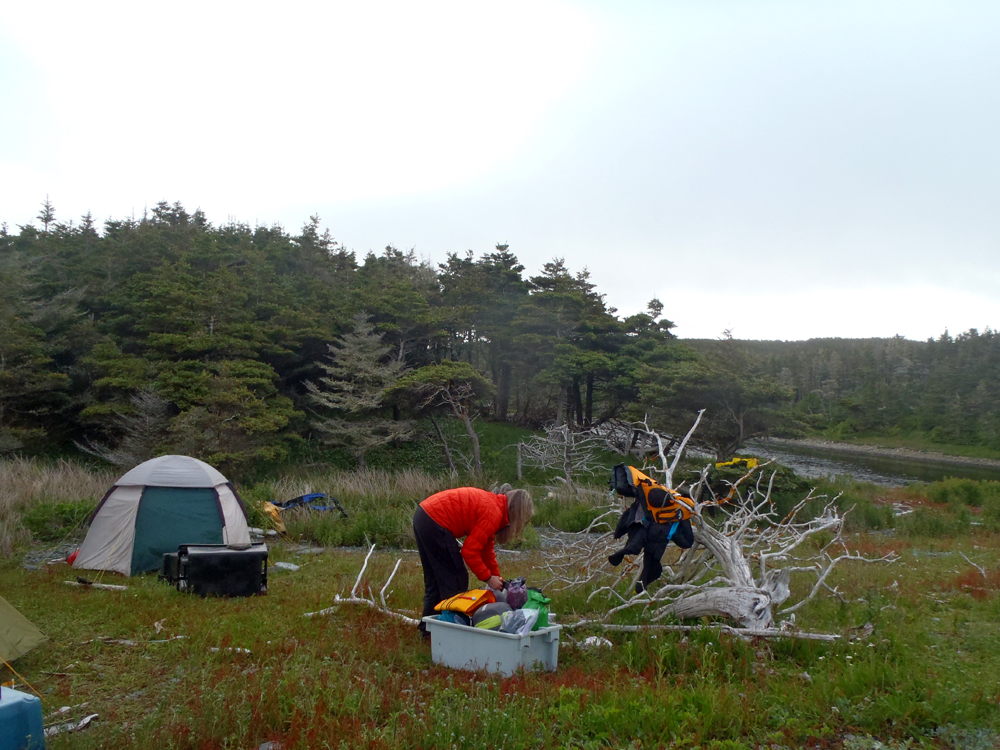
We arrived in Wild Cove on Great Colinet Island on Saturday for our one night club kayak camp trip.  Sunday morning it was time to pack up and head home.  Under cool, grey skies everyone had breakfast, well, most of us except the late sleepers and broke camp.


We paddled into Wild Cove on the east side where the rocks dipped to the west.  Leaving on the west side the rocks dipped to the east, which means???  Wild Cove sits in the axis of a syncline!


All along the west side the weaker sedimentary beds were eroded making passages to paddle through.


At South Point we paddled under massive cliffs that ...
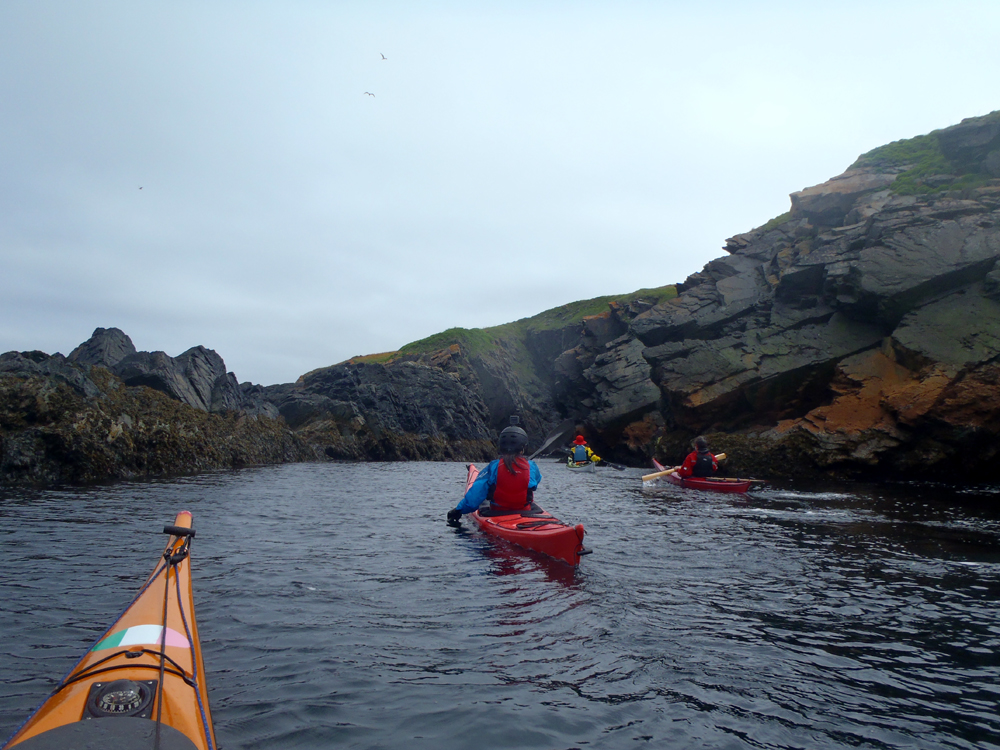

... trailed off towards the west side of the island with little coves to investigate.


Rounding the last corner we were face into the wind.  The forecast for Sunday was an easterly wind which would have afforded the group protection until the crossing back to Admirals Beach.  It didn't quite work out that way as winds were more NNE so it was a little more of a workout than anticipated.


The husband and wife team of Brian and Sue.  The more experienced paddlers spaced themselves out among the group to make sure everyone was safe.


I looked across at Cathy and thought how the verdant hills matched the green of her kayak.  What a trooper paddling on without breakfast, well, a banana and a granola bar.


We had a tow to do in the wind.  I saw a rope in the water and realized Dean had a customer.  I called out I would hook on to him and we'd do a tandem tow.  After some time Hazen and Clyde took over and had a turn.  We rested in the protection of this small cove before ...


... Shane and Derek took a turn.


As we approached Back Cove we stopped and everyone took a breather.  I sampled some of Sarah's curry dip finding it went well with baby carrots, even watermellon and Cathy's brownies *lol*.  That and some of Shane's trail mix and I was good to go again.


The wind seemed to drop after our stop making the passage across Regina much easier dispensing with the need for the tow.  At, what I understood to be Mother-in-Law rock, we made the turn for Admirals Beach 1.5 kms across to the mainland.  The small wind waves on the beam made paddling easier for everyone having paid our dues earlier in the morning.


Back at Admirals Beach with Great Colinet Island in the background.  Dave the beluga was still hanging out in the harbour so some decided to have a swim with him while the rest of us unloaded our kayaks.

It was only a short one night trip but it was filled with adventure and a great bunch of 15 other adventurers.  Thanks to Dean and Hazen for organizing the trip.

You can catch another take on the trip at Shane's blog.

Tuesday, July 12, 2016

Great Colinet Island (2016) Part 2


After our tour of the resettled community of Mosquito on Great Colinet Island we got back in our kayaks and paddled south along the east shore.  Not long after leaving Mosquito the shoreline began to look more imposing.  Some of us paddled close to the cliffs where there was a little action created by the wind waves.


We passed by several caves.


Pushed by the wind it wasn't long before we were at the south end of the island and the entrance to Wild Cove where we would ...


... set up our tents and become ...


... the largest and only community on the island.


There is a good reason the place is called Wild Cove.  It is open to the south with unlimited fetch from the south.  Next stop south from here is Bermuda, if your lucky to hit it.  With that in mind we carried the kayaks well up onto the high beach plateau.


After the tents were set up and kayaks secured we went for a hike to the south headland we had passed to enter the cove.  All along the high ground the tuckamore was evidence of how strong the wind can get.  Tuckamore is a Newfoundland term for stunted fir and spruce trees that grow low to the ground and lean away from the direction of the wind.  The strong wind stunts their growth as can be seen from the thick trunk but its low height.


Near the headland and looking back into the cove where our tents stood the land was a sea of yellow buttercups and reddish sorrel.


Our group at the headland minus Rob who had gone earlier for a run.


Back from the headland in the distance, it was time to get supper going.


The sun began to set and it got noticeably cooler so we set about collecting some wood for our camp fire.  As the fire grew and the temperature fell the group ...


... crowded closer to the fire.


We took turns tending to the fire.  People drifted away to their tents as the night wore on bringing an end to our first day at Great Colinet Island.  It was good night Irene.

Monday, July 11, 2016

Great Colinet Island (2016) Part 1


Paddle Newfoundland and Labrador's introduction to kayak camping trip happened this past weekend (July 9 - 10) on Great Colinet Island.  We met at 9:00 to convoy out to Admirals Beach in St. Marys Bay where we carried the kayaks to the water's edge and began to fill them with the necessities for camping.


The weekend started off with a bang.  A beluga had been hanging out in the harbour for a couple of months.  As we got on the water and floated waiting for everyone to launch it swam around checking us out.  It wasn't chased or harried.  We shared a mutual curiosity about each other.


Finally, just after 11:30 a flotilla of 16 kayaks set off across on the short crossing to Great Colinet Island.


Dean and Hazen led the trip.  Our first port of call was the location of the resettled community of Regina (pronounced locally as Regeena) where, at 12:30, it was close enough to lunch time to have a bite to eat.


Leaving Regina the next destination was the resettled community of Mosquito.  We had a little wind and following sea that pushed us along under bright blue skies.


We had the good fortune to have Sarah as part of the group.  Some of Sarah's ancestors were from Mosquito so she was familiar with the history of the place.  She showed us around the cemetery and pointed out the location of the community church.  I had been here several times before and completely missed the outline of the former church hidden in the trees.


Now, Mosquito is the subject of one chapter in Scott Walden's book "Places Lost - In search of Newfoundland's resettled communities".  Here Sarah kneels next to the headstone of her great grandfather Casimir Doody.  I asked her to pose because I just thought it was appropriate and sort of a circle closed.  As chance would have it Walden has a picture of the same headstone of Casimir Doody on page 94 of his book but without the growth that surrounds it now.

The census of 1921 shows Casimir was born in 1897 and married to Sarah, living in the household of father Bernard with a 7 month old son Brenard (typo in census??).  So, Sarah, kneeling told us she was named for her great grandmother.


We walked through the heavily grown over graveyard reading the names and dates of death until we came to the old entrance.  When I was here previously I thought the stones set in the pillars were decorative but there was a significance to the design and placement.  Sarah explained there were 33 stones set in each face representing the age of Christ at the time of his crucifixion.

Walden's book has a picture of the entrance also on page 93 with the gate still hanging.  It is now unhinged and standing beside the pillar on the right.


The graveyard is on the hill behind us.  On our walk back to the beach where our kayaks were Sarah showed us the foundation of her grandparents' house.  The 1921 census lists 45 souls living in 11 households.  Casimir's family by 1935 had grown to 9 - 4 sons and 3 daughters (Eta, Agnes and Ellen).  One on them must have lived here.


The surprising thing about the resettled community is the amount of open space that had not been reclaimed by the trees.  Preparing to leave, I took a parting shot looking over the water towards Admirals Beach.  Again, I was in step with Walden as he has a similar picture of the same tree on page 101.

These resettled communities are a favourite kayak destination for me.  This time with Sarah whose explanations and comments put Mosquito in a new light.

Next stop, Wild Cove on the south side of the island where a city of 16 tents would spring up.

Wednesday, June 25, 2014

The bones of Mosquito


We arrived at the abandoned community of Mosquito on Great Colinet Island after leaving Wild Cove earlier Sunday morning.  We had only been on the water about an hour and less than an hour from the take-out so we had lots of time and stopped for a look around.

About all that's left in Newfoundland's abandoned communities are stone foundations and headstones in graveyards.  This lonely weathered dead tree trunk was the first thing that caught my eye as I made my way to the cemetery at the top of the hill.

It looked like a woman turning to wave good-bye.


Further along I spotted this planting of narcissus.  They are not native so someone planted them here to admire.  I wondered who.  Maybe they were planted in front of a kitchen window to brighten the view for the matron of the house as she washed dishes.  Now, they are left to grow alone amidst the grasses forgotten by the gardener who has moved on.


A concrete foundation also lay in the grass.  Did a house stand at this location?  If so, did it resound with the laughter of children?  Did it ache with the passing of a mother or father?  Who knows?  All that's left are faded memories.


Here stands the entrance to Mosquito's graveyard, the repository of the former community's history as told by the names on the grave markers.  The cobbles imbedded in the posts still wore their colours of red and green.

They stand here now as two isolated sentinals that once bore witness to parades of mourners as they carried the remains of their loved ones to their final resting place.


One cold day in January 1898 Patrick Linehan helped carry his beloved wife through the gate and laid her to rest.  Its not that difficult to conceive of a group of mourners standing around the grave with breaking hearts and tears falling as people still do today at the passing of a loved one.


 Mary Linehan was buried more than a hundred years ago.  A hundred years is nothing in the grand scheme of things.  The people of Mosquito moved on and trees grew in the untended graveyard.


 And trees blew over.


Walking down from the graveyard these two trees overlooking Colinet Passage caught my eye.  Two trees standing in a wide open field where once a thriving community lived.  In 1921 the population stood at 45 in 11 households.  By 1945 the population had grown to 70 souls.  In the early 1960's the community was resettled off of the island and people moved to other existing communities on the mainland.

The flesh has been stripped off of Mosquito as in so many other Newfoundland resettled communities.  All that remains are the bones.  So much dust in the wind.

Tuesday, June 24, 2014

Leaving Wild Cove for home


On Saturday Brian, Clyde, Dean and I had paddled from Admirals Beach to Wild Cove on Great Colinet Island where we camped.  Hazen joined us later in the day.  After roasting a duck, having a few swallies and a fire we hit the hay with the sound of seagulls overhead and the surf pounding on the shore.

In the morning we had breakfast, broke camp and left Wild Cove.


We rounded Wild Head, which it was, wild that is, and paddled northerly along the southeast side of Great Colinet Island.  The cliffs were higher along this side than elsewhere on the island as we drifted into small coves with caves.


We only had 9 kms to paddle back to the cars in the morning so we took our time to enjoy the scenery.


The morning that started overcast began to brighten as we made slow progress up the east side.  Maybe there was a bit of reluctance to end the trip too soon.


The further north we went the land lost its height and some of its interest.


About 5 kms from Wild Cove we got out to have a look around the abandoned community of Mosquito.  The main point of interest there now is the graveyard which is set on top of a low hill overlooking the now vacant fields.

Mosquito is one of the abandoned communities featured in the book "Places Lost" by Scott Walden.


Leaving Mosquito, which makes it sound like its still a place, we weren't far from the north end of the island and the short crossing back to ...


... Admirals Beach.  End of trip.  Almost.  A stop for a meal of fish and chips on the drive home and it was complete.

It wasn't a weekend of a lot of paddling.  The distance to our camp site in Wild Cove was only a tad over 14 kms but it was a bit of work in the wind.  The return was a short 9.3 kilometer paddle in calm conditions.

We knew beforehand the trip would not offer a lot of paddling but the focus was more on getting away.  The highlight was the roasting of the duck.  Dean wondered how the duck would turn out.  I replied that either way, it had a lot of entertainment value.

The duck was fine and the trip was excellent.  Thanks guys for sharing the weekend.

Here's a link to Dean's blog and detailed account of the trip.